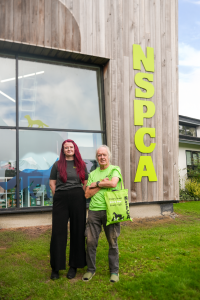
The NSPCA will today (30.09.26) appear before the Joint Oireachtas Committee on Agriculture and Food for pre-legislative scrutiny of the General Scheme of the Dog Breeding Establishments (Amendment) Bill 2026.
While welcoming positive measures in the proposed legislation—such as new criminal offences, statutory regulation powers, age limits for breeding females, and restrictions on puppy sales and seizure powers—the NSPCA is today highlighting a number of key areas where the Bill could be strengthened to help create a breeding system that places animal welfare at its heart, while supporting responsible breeders.
Representing the NSPCA before the Committee are Conor Dowling (Director of Advocacy and Policy), Dr. Elise O’Byrne White (NSPCA Veterinary Director), and Superintendent Inspector Bartley Finnerty.

Conor Dowling, Director of Advocacy and Policy at the NSPCA, said: “At the NSPCA we see first-hand how weaknesses in our current legislation and regulation are impacting the welfare of thousands of dogs and puppies across the country. While we welcome the proposed reforms, and the opportunity today to discuss the legislation, we believe that there are a number of areas where the current proposals can be strengthened to help ensure that commercial breeding establishments are subject to robust standards of animal welfare, transparency and accountability.
From a recent survey conducted by the NSPCA, we know that 90% of the public support stricter regulation of puppy farming. The Oireachtas must seize this opportunity to broaden legal definitions, cap facility numbers, and establish a national inspectorate so that Ireland’s reputation for large-scale puppy farming becomes a thing of the past.”
NSPCA’s Key Revisions to the Legislation
The NSPCA is outlining six key recommendations to strengthen the Bill:
- Broaden the Definition of Breeding Establishments: Bring more commercial breeders under legal oversight based on scale and activity, ending the current situation where the majority of puppies are bred outside statutory protections.
- Review the proposed staffing ratio: The proposed ratio of one staff member per 20 breeding females ignores male dogs, non-breeding females, and litters—potentially leaving one worker caring for upwards of 40 animals (just 10–12 minutes of care per dog in an eight-hour shift).
- Strengthen Seizure Powers: Align seizure provisions with the Animal Health and Welfare Act to allow prompt seizure and rehoming when improvement notices are ignored.
- Limit the number of breeding dogs permitted at a single establishment: Introduce a mandatory cap on adult female breeding dogs per facility, aligning with international standards such as New South Wales where limits are set at 20 adult females.
- Establish a National Inspectorate: Replace fragmented inspection structure with a dedicated, fully resourced national inspectorate to encourage uniform enforcement nationwide.
- Enable greater transparency: Information on licensed establishments, inspection findings and enforcement action should be readily accessible, enabling prospective purchasers to make informed decisions and increasing public confidence.